

 By
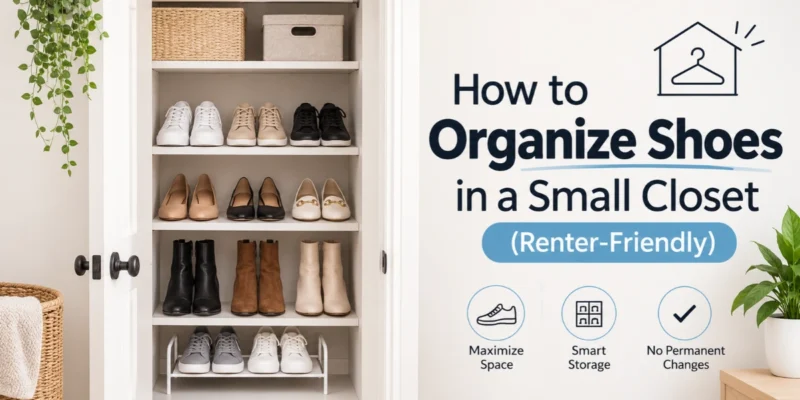
Shoes and small closets are a hard mix, because shoes are bulky, uneven and come in pairs. Knowing how to organize shoes in a small closet comes down to one move: stop storing them flat on the floor. A pile of shoes eats more floor than anything else you own, and it always buries the pair you want. The fix is to use height, the back of the door, and the space under your bed. This guide covers eight renter-friendly ways to do it, with no drilling and nothing you cannot undo before move-out. Whether you own ten pairs or forty, one of these setups will fit. Grab your shoes, a tape measure, and about an hour.
Quick answer: Here is how to organize shoes in a small closet: cull the pairs you do not wear, sort the rest by type and how often you wear them, then lift them off the floor with a stackable shelf, slanted rack, or over-the-door pockets. Store off-season pairs in bins under the bed. Every option here works without drilling.
How to Organize Shoes in a Small Closet: Start With an Audit
Line up every pair on the floor. Seeing them together is the fastest way to find the problem.
Sort them into three groups: pairs you wear every week, pairs you wear by season, and pairs you have not touched in a year. Check condition as you go. A worn-out heel or a split sole means repair it or let it go. Be honest about comfort, too. Shoes that hurt stay in the closet, and in the way.
For the “just in case” pairs, set a deadline. Put them in a bag with today’s date. If you have not opened the bag in six months, donate it.
While you are at it, measure the closet floor and any shelves. Our guide to how to organize a small closet covers the rest of those measurements.
Sort by Type and How Often You Wear Them
Shoes are not all the same shape, so they should not all live the same way.
| Shoe type | Best home | Why |
|---|---|---|
| Everyday sneakers and flats | Floor shelf or low rack | You grab them daily |
| Heels and dress shoes | Slanted rack or labeled boxes | Keeps heels from crushing |
| Boots | Floor, upright, or on clip hangers | Stops shafts from folding |
| Sandals and flip-flops | Over-the-door pockets or a basket | Light and flexible |
| Off-season pairs | Bins under the bed or on a high shelf | Out of the way until needed |
8 Ways to Organize Shoes in a Small Closet
Pick two or three that suit your closet. Most small closets need a mix, not just one.
1. Stackable shoe shelf
A freestanding two- or three-tier shelf turns one footprint into several levels. Measure your closet depth first. A shelf deeper than the space will stop the door from closing.
How to organize shoes in a small closet that is shallow
Choose a slim, narrow rack made for tight spaces, or angle the pairs so they use less depth. You can also store each pair stacked, one shoe on top of the other, which narrows its footprint.
2. Slanted rack or shelf riser
Slanted racks tilt each pair so it uses less depth. A shelf riser adds a second level on an existing shelf. Both are good for heels and flats.
3. Over-the-door pockets
Pockets work best for flats, sandals and kids’ shoes. Keep heavy boots off the door. Most interior doors are about 1⅜ inches thick, so check the organizer’s rated thickness, and confirm the door still closes.
4. Tension rod rack
How to organize shoes in a small closet with a tension rod
Mount a tension rod low in the closet and hang boots or heels from it with clip hangers. Tension rods slip under heavy loads, so keep the load light and check the weight rating.
5. Under-bed bins
Shallow bins with lids keep off-season shoes clean and out of sight. Measure the clearance under your bed frame before you buy, and slide the bins out once a season to check for dust and damp.
6. Clear drop-front boxes up high
Special-occasion shoes can live on a high shelf in clear boxes. Put a photo or label on the front, and keep the heaviest boxes at the bottom of the stack.
7. Hanging shoe cubbies
A fabric organizer hooks over the closet rod and gives you cubbies for flats and sandals. Check the rod’s weight limit first.
8. Move daily pairs outside the closet
Not every pair has to live in the closet. A slim rack by the front door holds the shoes you wear every day and takes pressure off the closet. See entryway organization for apartments with no foyer for layouts.
How to Organize Shoes in a Small Closet for Renters
Renting changes the rules, but all eight ways above work without drilling. The two to double-check are anything that hangs from a door and anything held by adhesive.
Shoes are heavier than they look. A single pair of boots can weigh several pounds. Check the rating on every hook, rod and pocket organizer before you load it.
Read your lease before you use adhesive on a wall. Photograph the closet on move-in day, and ask your landlord before you add anything permanent. If your lease bans adhesive, skip it. Every method here still works.
How to Organize Shoes in a Small Closet on a Budget
You can do a lot for free:
- Stack sturdy shoe boxes on their sides to make cubbies.
- Use cardboard dividers to separate pairs.
- Reuse a laundry basket for sandals and slippers.
If you spend anything, spend it on one good shelf or one door organizer.
How to Organize Shoes in a Small Closet for Apartments
Apartment closets are often narrow, with sliding doors that give you access to only half the space. Keep daily shoes on the side that opens fully, and use the harder side for off-season pairs. Sharing the closet? Give each person one shelf level.
If your only closet also holds coats and towels, keep shoes at the bottom and everything else above. These guides can help with the rest: how to organize a small coat closet and linen closet organization ideas for small apartments.
Wet shoes do not belong in the closet. Put a tray by the front door for rainy days, and let them dry before they go in.
Keep Shoes Fresh and Organized
Any plan for how to organize shoes in a small closet only works if you maintain it. Let shoes dry completely before you store them, and air them out if they smell. Use boot shapers, or rolled-up paper, so shafts stay upright. Leather and suede need air, so avoid sealing them in airtight plastic for months.
Follow a one-in, one-out rule so the closet does not fill up again. Rotate your off-season pairs when the weather changes. For systems that work in every room, see our full guide to small space storage ideas.
Common Mistakes
- Buying a shelf before measuring. A rack that blocks the door is useless.
- Overloading a tension rod or door organizer. Shoes are heavy.
- Storing damp shoes. They will smell, and some materials can be damaged.
- Keeping shoes you never wear. Every unused pair takes space from one you do.
- Stacking boxes with no labels. If you cannot find the pair, you will not wear it.
Your First Step
Now that you know how to organize shoes in a small closet, you do not need to buy everything at once. Cull your pairs, pick one or two of the ways above, and set them up this weekend. Then add the next one when you are ready.
FAQs
How many pairs of shoes should fit in a small closet?
- There is no fixed number. Line up your pairs and measure the space you have, then give each pair its own spot. If a new pair has no spot, an old pair goes.
What is the best way to store shoes with no floor space?
- Use over-the-door pockets, under-bed bins and a high shelf with clear boxes. Together they hold a lot of pairs without using any of the closet floor.
How do I organize shoes without a shoe rack?
- Stack shoe boxes on their sides, use crates as cubbies, or hang boots from a tension rod. A fabric hanging organizer also works without any rack.
Should shoes go in the closet or by the door?
- Keep the pairs you wear every day by the door, where they can dry, and store the rest in the closet. That keeps both spaces easier to manage.
What's your reaction?





[…] Shoes deserve their own plan, so see our guide to organizing shoes in a small closet. […]
[…] guide: How to Organize Shoes in a Small Closet […]
[…] Give shoes a tray and a limit. A boot tray defines the spot and catches meltwater and grit. Keep two or three current pairs per person here. The rest can go in the bedroom, as covered in how to organize shoes in a small closet. […]