

 By
Living room no focal point? You’re not alone. Many apartments and newer builds come with no fireplace, no feature wall, and no obvious place for your eyes to rest, so furniture drifts to the edges, and the room feels unfinished. The good news is that you don’t need a renovation. You need one deliberate anchor, a clear viewing order, and seating that points toward it. This guide shows you how to find the focal point your room already has, create one when it doesn’t, and do it on a budget or as a renter.
Quick answer: To fix a living room with no focal point, choose one wall, window, or feature to be the star. Make it the boldest or largest thing in the room, point your main seating toward it, and keep every other wall quieter. One strong anchor beats three weak ones, especially in small spaces.
Signs Your Living Room Has No Focal Point
A focal point is the spot your eye lands on first when you walk in. When a room doesn’t have one, you usually feel it before you can explain it. Common signs:
- Your eyes bounce around the room instead of settling anywhere.
- Every piece of furniture sits against a wall, with nothing pulling the group together.
- The TV is the only thing that draws attention, and it’s off most of the day.
- The walls are either bare or dotted with small frames that all carry the same weight.
- Photos of the room look flat, even though each item in it is nice.
If two or three of those sound familiar, the problem is rarely your furniture. It’s hierarchy. Designers call this visual hierarchy: a few things should be loud, some medium, and most should stay quiet. A room where everything speaks at the same volume reads as a living room with no focal point.
Living Room No Focal Point: How to Find the One You Already Have
Before you buy anything, check whether the room is already hinting at an anchor. Two quick tests will tell you.
Living Room No Focal Point? Try the Squint Test
Sit on the sofa and squint until the room blurs. Notice which shape, bright patch, or dark patch still stands out. A bright window, a black TV screen, or a tall bookcase often wins by default.
If what stands out is something you like, that’s your starting point. If it’s a TV or a cluttered shelf, you’ve just learned what to fix.
The Doorway Test
Stand in the entrance and notice what meets your eye first. This is the view your guests get. In most layouts, the wall straight ahead gets the most attention, which makes it the strongest candidate for a feature wall or statement piece.
Natural Anchors Worth Using
Look for features that already have pull:
- A large window, especially one with a view
- An architectural detail such as an arched opening, bay window, alcove, or exposed brick
- A built-in shelf or recess
- The wall directly opposite your main seating
If you have one, enhance it instead of competing with it.
How to Create a Focal Point in a Living Room: Pick Your Type
When nothing natural exists, you build one. Almost every focal point falls into one of four families, and each suits different rooms and budgets.
| Type | Best for | Budget | Renter-friendly? |
|---|---|---|---|
| Feature wall (paint, panels, wallpaper) | Rooms with one clear, uninterrupted wall | Low to medium | Often, with removable options |
| Statement object (art, mirror, furniture) | Small rooms and rental walls | Low to high | Yes |
| Light feature (lamp, sconces, window glow) | Dark rooms and evening use | Low to medium | Yes, with plug-in options |
| View or architecture (window, arch, alcove) | Rooms with good bones | Free to low | Yes |
Pick one. Then add, at most, one smaller secondary accent elsewhere. That one-primary, one-secondary rule keeps the room from sliding back into a living room with no focal point.
Living Room Focal Point Ideas Without a Fireplace
Living room no focal point and no fireplace? That’s the most common version of this problem. These seven ideas work in apartments, rentals, and small homes.
1. One Oversized Piece of Art or a Large Mirror
Big beats busy. A single large piece reads as one confident statement, while several small frames read as clutter. Aim for something roughly two-thirds to three-quarters the width of the furniture below it, and hang it or lean it on the wall you chose. A large mirror also bounces light, which helps in dark rooms.
2. Make the Window Wall the Feature
Windows are free focal points. Hang curtains wide and tall so the window looks larger, then frame it with a chair, a plant, or a small side table. If you have a good view, keep the glass clear and let the outdoors do the work.
3. An Electric Fireplace or Faux Mantel
If you miss having a fireplace, add one. Plug-in electric inserts and freestanding mantels bring a classic anchor to a blank wall, and many need no installation, which suits renters. Follow the manufacturer’s clearance instructions. Then style the top simply: one tall object, one low object, and one personal item.
4. A Credenza or Sideboard Vignette
A low, long piece of furniture on the focal wall gives the room a visual base. Top it with a lamp, a stack of books, and one piece of art above. Vary the shapes: something tall, something round, something low. This works well when a wall can’t take paint or a heavy installation.
5. Statement Lighting
Lighting draws the eye even when it’s switched off. An arc floor lamp, an oversized shade, or a pair of plug-in sconces can turn a corner or wall into the anchor. At night, a warm pool of light makes it stronger. Choose warm white bulbs, around 2700K, to keep the mood cozy.
6. A Styled Bookcase Wall
A tall bookcase filled with a mix of books, objects, and breathing room can turn an empty wall into the focus. Leave a few shelves partly open so it doesn’t feel heavy.
7. A Bold Rug When the Walls Are Off-Limits
If you can’t touch the walls, anchor the room at floor level. A rug with strong color or pattern pulls the seating together and gives the eye a place to land. Keep the front legs of your sofa and chairs on it, and keep the rest of the room calmer. Not sure what size to buy? Check our rug size guide for living rooms.
How to Create a Focal Wall in a Living Room
A focal wall works because it tells the eye where to go. It also backfires when it’s the wrong wall or when it has company. Here’s how to get it right.
Step 1: Choose the Right Wall
- Pick the wall you see first from the doorway, or the one your main seating faces.
- Favor a wall with few windows, doors, or vents breaking it up.
- If the TV wall is your only option, treat it as part of the design.
Step 2: Pick a Treatment
Common options include a deeper shade of paint, wood slats or board-and-batten, wallpaper, or an art-led wall built around one large piece. Choose the treatment that fits your lease and budget.
Renter-Friendly Fixes for a Living Room With No Focal Point
- Peel-and-stick wallpaper or removable panels
- A leaning floor mirror or oversized canvas
- A large textile hung with removable hooks
- A freestanding shelf or screen placed against the wall
Check your lease first, and test any adhesive on a hidden patch.
Living Room No Focal Point on a Budget
Paint is usually the cheapest way to create a focal wall. A thrifted mirror, or a piece of fabric stretched over a simple frame, costs far less than built-ins and still gives the room a clear anchor.
Step 3: Keep It to One
A focal wall only works if the other walls stay quieter. If you paint one wall deep green, keep the others a soft neutral and let the rug and pillows stay calm.
Living Room Focal Point Ideas for Small Spaces
Small rooms can’t carry competing statements. Living room no focal point in a small space? The goal is one clear focus with plenty of quiet around it.
Use the Wall Farthest From the Door
Putting the focal point on the far wall pulls the eye through the room, which makes the space feel deeper.
Go Vertical
When floor space is tight, use height. A tall mirror, floor-to-ceiling curtains, or a narrow bookcase carries the eye upward and leaves the floor open.
Keep the Rest of the Room Quiet
In a small room, limit yourself to one bold pattern or color and keep surfaces clear. A calm background makes a modest focal point feel intentional.
How to Arrange Living Room Furniture Without a Focal Point
Living room no focal point and nothing to face? Arrange around people instead. Conversation becomes the focal point.
- Start with the seating group, not the walls. Place the sofa and chairs around a rug and coffee table so people face each other.
- Pull furniture off the wall. Even a few inches of space makes a group feel placed, not parked.
- Angle one chair. Turning an accent chair slightly toward the sofa creates a relaxed, inviting shape.
- Mind the distances. Aim for about 14–18 inches between the sofa and coffee table, and about 30–36 inches for walkways.
- Finish the sight line. Put a lamp, plant, or piece of art at the far end of the room so the eye has somewhere to travel.
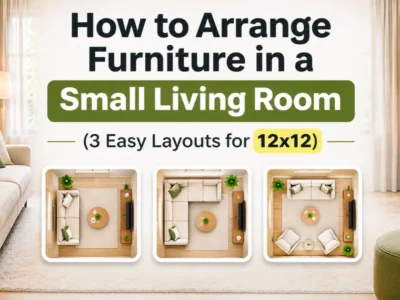
Need exact layouts for a 12×12 room? See how to arrange furniture in a small living room.
Living Room Design Ideas Without a Focal Point (When It’s Intentional)
Some rooms don’t need a single star. Open-plan and multi-use rooms often work better with several small anchors.
Create Zones, Each With a Mini Focal Point
Give each zone its own anchor: a rug and lamp for the seating area, a chair and plant for a reading nook, a desk and art for a work corner. Keep a hierarchy so one zone leads and the others support it.
When the Front Door Opens Into the Living Room
In many apartments, the entry is part of the living room, so shoes, bags, and mail become the loudest thing in sight. A tidy entry keeps it from stealing attention. See our guide to entryway organization for apartments with no foyer.
When the TV Is Your Only Focal Point
A dark rectangle draws attention without feeling designed. Don’t fight it. Frame it with shelving, art, or a warm lamp on either side so it’s part of the composition and not the whole show.
Common Mistakes When Your Living Room Has No Focal Point
- Stacking competing statements. A loud rug, a gallery wall, and a bold sofa all at once cancel each other out.
- Choosing art that’s too small. Small pieces on a big wall disappear.
- Pushing everything against the walls. It leaves a hole in the middle and no center of gravity.
- Ignoring lighting. An unlit focal point loses half its impact after dark.
- Buying before measuring. Statement pieces need the right scale for your wall and your room.
- Hanging art too high. A common guideline is to center art at roughly 57–60 inches from the floor.
A Simple Three-Step Plan
- Diagnose (10 minutes). Run the squint test and the doorway test.
- Choose one type. Use the table above and commit to a single anchor.
- Rearrange and edit. Turn your seating toward the anchor, then remove or relocate anything competing with it.
Conclusion
A living room with no focal point isn’t a design failure. It’s a missing decision. Run the two quick tests, pick one anchor, and point your seating toward it. Then keep everything else a little quieter. For more ways to make a compact space work harder, browse our small living room ideas guide.
FAQs
How do I fix a living room with no focal point?
- Pick one anchor, such as a large piece of art, a feature wall, a window, or statement lighting. Point your main seating toward it and remove anything that competes with it. One strong focal point works better than several weak ones.
Does every living room need a focal point?
- Not strictly, but most rooms feel more finished with one. A focal point gives the eye a place to rest and makes furniture look arranged on purpose. Large open-plan rooms can use several small anchors instead.
How many focal points should a living room have?
- One primary focal point and, at most, one secondary. More than that and they compete, which is how a room ends up feeling like it has none. In open-plan spaces, give each zone its own small anchor.
What can be a focal point if I don’t have a fireplace?
- Large art or a mirror, a styled bookcase, statement lighting, a window wall, a credenza vignette, or an electric fireplace all work. In rentals, a bold rug or leaning artwork works without touching the walls.
How do I create a focal point in a living room on a budget?
- Start with paint, a thrifted mirror, or a large piece of fabric on a frame. Rearranging your furniture to face one anchor costs nothing and often does half the work.
Can renters create a focal wall?
- Yes. Use peel-and-stick wallpaper, removable panels, a leaning mirror, or a large textile hung with removable hooks. Check your lease first and test any adhesive on a hidden patch.
Should the TV be the focal point?
- It can be, but it doesn’t have to be. If the TV is your only focal point, frame it with shelves, art, or lighting so the wall feels designed even when the screen is off.
What's your reaction?